
I made a quick visit to Isfahan, the former capital of Shah Abbas I, in Iran. Air Arabia took me over Musandam from Muscat into Sharjah.

The Strait of Hormuz navigation width at Musandam for large ships is less than 40km wide – and it allows shipping to sail from the Arabian Gulf (perhaps as this is about Iran I should say Persian Gulf) into the Gulf of Oman (or the updated version of the same water – Oman Sea). The ships coming out of the Arabian Gulf, laden with oil, use the deepest lane closest to Musandam’s coast – the empty tankers, needing less depth, are still within Oman’s territorial water but farther out; the effect is of a dual carriageway of vast ships.

Landing in Shahid Beheshti International Airport at Isfahan, it was obvious that its buildings had not been modernised for years, perhaps since the Iranian revolution.
Unfortunately, the taxi I had organised through the hotel wasn’t anywhere to be seen. However, a couple of Isfahanis correctly judged my problem – and kindly drove me to the hotel. There isn’t a huge choice of accommodation in Isfahan, and what there is seemed to be expensive for the standard they might offer; and so it turned out. I made my choice simply as a combination of the price, but equally importantly, because it was the closest I could find to Naghsh-e Jahan Square.

The famed square is a classic Persian ‘garden of paradise’, an enclosed formal space based on a grid, usually sunk and with water features; a descendant of the first formal gardens at Persepolis. It also might be said to represent Iran itself with the merchants, religion and political power co-existing in a planned space.

Enclosing the square is an elegant bazar, with identically planned shops having an entrance onto the square and into the covered interior of the Bazar Bozorg; which held a little representation of England. The bazar links three separate major buildings from the early 17thc .
One of the impressive aspects of Isfahan – and further afield in Iran – is that the products in the shops were manufactured in Iran. The country is self-sufficient to a remarkable degree, unlike countries across the water in Arabia – which have a vast two-way flow of ships creating an interdependency of trade.

The Ali Qapu Palace appears to be a pavilion from which to see from – it has a Loggia facing the square – and can be seen from the square – Buckingham Palace in a different ambience. Inside a series of often elaborately decorated rooms rise above the square. In the early 17thc Robert Shirley arrived from England into Isfahan, where he married Teresa an Iranian Christian.

In Ali Qapu Palace Isfahan a stucco portrait shows a man and a woman in European style dress, perhaps the Shirleys or maybe Dutch traders – though I doubt these traders – as would they be travelling with wives?.

Opposite Ali Qapu Palace is the much-admired Sheikh Lotfollah Mosque. A tunnel under the square linked the Ali Qapu Palace and the mosque. The mosque itself is an enclosed, secure space.

The mosque was renovated in the early 20th c. by Reza Shah Pahlavi who also permitted non-Muslims to visit this previously private royal mosque, to all non-Muslim visitor’s great benefit – I appreciated the opportunity a lot.

On the square’s south is the Shah Mosque a traditional open Iwan style mosque from the early 17thc, with a series of substantial courtyards.

The Bazar Bozorg connects Naghsh-e Jahan with an even earlier public square about a 2-kilometre walk north through the amazing arched brick walkways.

These eventually lead to the 8thc Jameh Mosque that is next to this earlier square. Like many public buildings in Isfahan, this mosque is under renovation. Happily, visits are still possible and this enabled me to see the massive paving stones used for the floors, presumably similar stone is used in the other mosques.

To the west of Naghsh-e Jahan Square is another palace, Chehel Sotoun, set in an elegant garden.

As with so many palaces in Isfahan, this has beautiful paintings which portray court life.

South of this impressive area of historic buildings, boulevards extend toward the river.

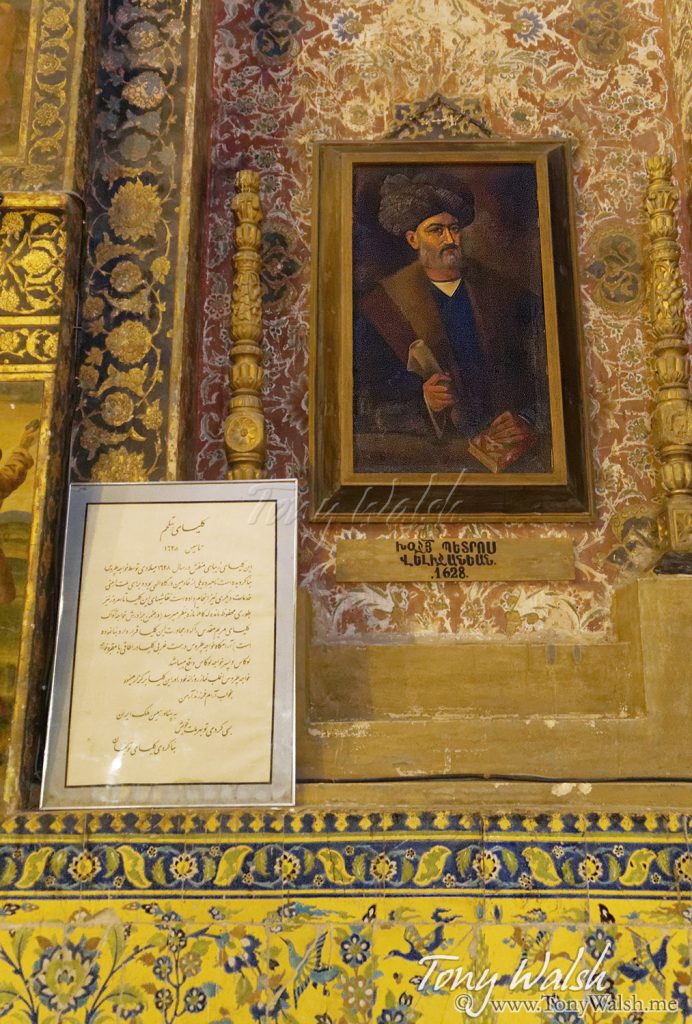
The mid 17thc Khaju Bridge leads to the Bidekhem Church Isfahan – the walk was delightful.
Isfahan deserves more time than a couple of days which was all I had.

Perhaps the sight of Oman Air on its way into Tehran, means that I will be on a future flight into Iran. We left Iran’s airspace over Bandar-e Chiruiyeh, one of the numerous small fishing ports on The Gulf.

Fantastic photos, Tony. Isfahan is one of those places that has been on my wish list ever since I was in Oman and didn’t get there.
Thanks Mike
its a fantastic place and very walkable with no hassle at all
Hotels are overpriced (shortage of choice) but not outrageous
and with cheap flights rapidly expanding – overall relatively affordable.
Take a diversion next time you fly to India
It’s very tempting, especially as the very long short story I’m writing at the moment is set in Medieval Persia.
A great reason to go – Isfahan’s period may be a bit late – but there are cities that will fit. Air Arabia offers a good choice. Do note the visa requirements. Send me an email (contact page) if you want
Thanks, Tony. I shall definitely give it some consideration.